
The Short Answer
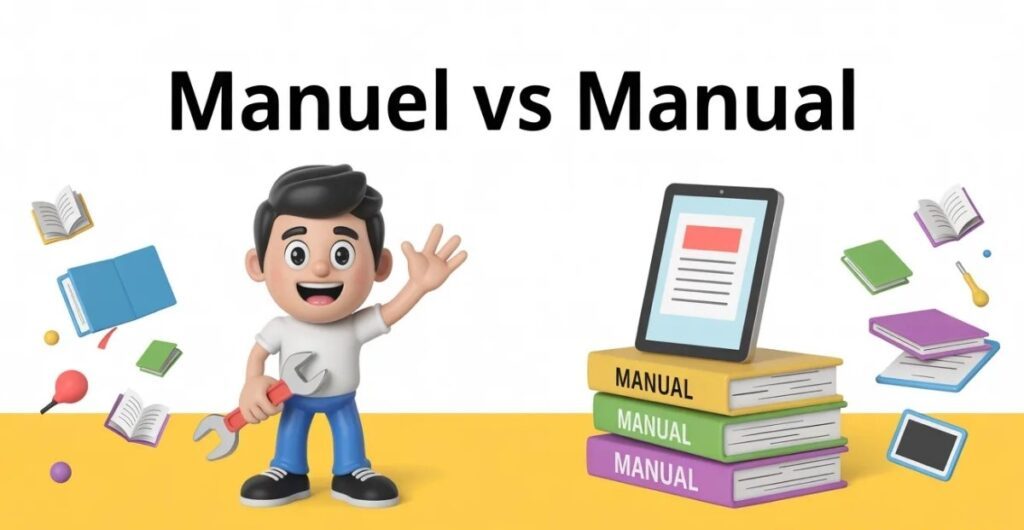
“Manual” is the word you almost always want. It’s an adjective meaning something done by hand or without automation (a manual transmission, manual labor), and it’s also a noun referring to an instruction booklet (a car manual, a user manual). “Manuel,” on the other hand, is a proper noun — specifically, a given name, the Spanish and Portuguese form of “Emmanuel.”
If you’re describing an action, a process, or a document, you want “manual.” If you’re talking about a person named Manuel, that’s the only time the second spelling belongs in your sentence.
Why People Mix Them Up
The confusion is understandable. The two words are separated by a single letter and look nearly identical at a glance, especially when typing quickly or relying on autocorrect. Because “Manuel” is a fairly common name, plenty of people have seen it written just as often as they’ve seen the word “manual,” which makes it easy for the brain to swap one for the other, particularly in casual writing like texts, emails, or social media posts.
Autocorrect and predictive text can make it worse. Some keyboards will “correct” manual to Manuel or vice versa based on what you’ve typed recently, which means the mistake can sneak into a message even when you typed the right word to begin with.
How to Use “Manual” Correctly
As an adjective, “manual” describes something operated by hand rather than automatically: a manual car, manual labor, a manual can opener, manual data entry. It contrasts directly with “automatic.”
As a noun, “manual” refers to a reference book or guide, usually one that explains how to use, operate, or assemble something: an owner’s manual, a training manual, an instruction manual. In both uses, it’s always lowercase unless it starts a sentence, because it’s a regular common word, not a name.
Example sentences: “I prefer driving a manual over an automatic.” “Check the manual before you try to reset the router.” “This job still involves a lot of manual work.”
How to Use “Manuel” Correctly
“Manuel” is exclusively a first name. It’s common across Spanish-speaking and Portuguese-speaking countries and has historical roots as a form of “Emmanuel,” a name with biblical origin meaning “God is with us.” Because it’s a proper noun, it’s always capitalized, and it only ever refers to a specific person.
Example sentences: “Manuel is starting a new job next week.” “I met Manuel at the conference in Madrid.” “Manuel Neuer is a well-known professional goalkeeper.”
There’s no version of a sentence where “Manuel” replaces the adjective or the instruction-booklet noun — if you’re not naming a specific person, the word you want is “manual.”
A Simple Trick to Remember the Difference
A quick mental test: if you could reasonably put “Mr.” or “Hey” in front of the word and have it make sense as a name, you want “Manuel.” If the word is describing how something is done or referring to a booklet, you want “manual.”
Another trick is to remember that “manual” contains the word “man” plus “ual,” tying it to the Latin root manus, meaning “hand” — the same root behind words like “manuscript” (hand-written) and “manufacture” (originally, made by hand). “Manuel” has no such root meaning; it’s purely a name, so there’s no shortcut definition to lean on beyond recognizing it as someone’s identity.
Other Word Pairs That Cause the Same Confusion
“Manuel” and “manual” belong to a broader category of near-identical word pairs where one is a common noun/adjective and the other is a proper name — think “Marcus” versus a made-up common word, or “Christian” the name versus “christian” the adjective. In each case, capitalization and context are the two biggest clues: names are capitalized and refer to specific individuals, while common words describe general concepts and stay lowercase mid-sentence.
Spell-checkers usually won’t catch a manual/Manuel mix-up, since both are valid, correctly spelled words — the software has no way of knowing which one you meant. That’s exactly why a careful re-read, rather than relying on autocorrect, is the most reliable way to catch this particular error before it ships in an email, essay, or article.
Where the Name Manuel Comes From
For anyone curious about the name itself, Manuel has deep roots in Spanish, Portuguese, and broader Christian naming traditions, derived from “Emmanuel.” It remains one of the most widely used names across Spain, Latin America, Portugal, Brazil, and Spanish-speaking communities worldwide, and it has been carried by countless notable figures across sports, politics, entertainment, and history. Female variants and related forms, such as “Manuela,” share the same origin.
Understanding that history can actually make the spelling distinction easier to remember: because “Manuel” is tied to a specific naming tradition rather than a general vocabulary word, there’s no reason it would ever substitute for “manual” in a sentence describing an action or an instruction book — the two words simply come from entirely different linguistic families that happen to look alike on the page.
Bottom Line
These two words will keep getting confused because they’re visually so close, but the rule is simple once it clicks: “manual” is the everyday word for hand-operated things and instruction guides, while “Manuel” is strictly a person’s name. When you’re proofreading, a quick search for the word in your document and a check of whether you’re talking about a person or a process will catch almost every mix-up before it goes out.