
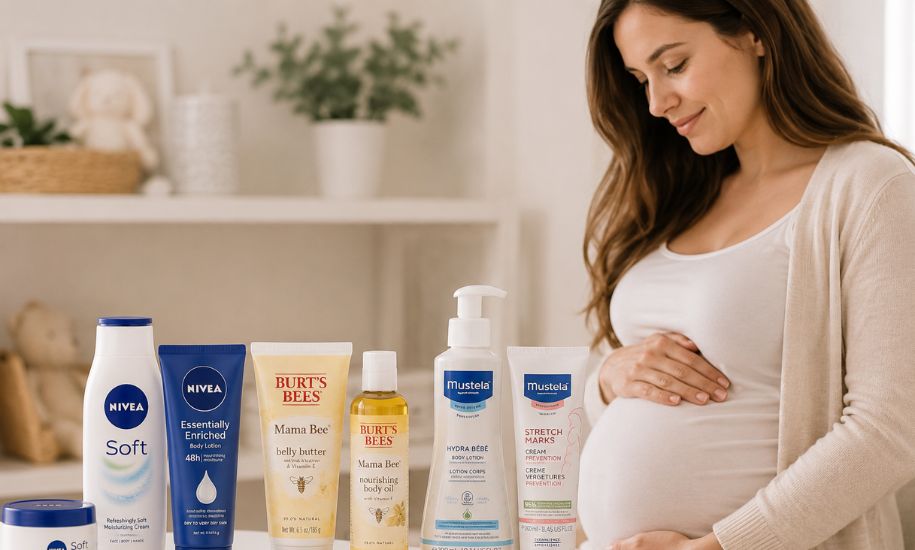
Pregnancy changes the way most women think about the products they put on their skin. A moisturizer that was an unremarkable, automatic part of a daily routine before pregnancy suddenly prompts a closer look at the ingredient list, and brand names that once felt interchangeable — Nivea, Burt’s Bees, Mustela — start to raise genuine questions. The honest, short answer is that no single one of these three brands is universally safer than the others; what actually determines safety is the specific ingredient list of the specific product, not the name printed on the front of the bottle.
Hormonal changes during pregnancy commonly affect the skin in ways that make this question feel more urgent than it might have before. Increased dryness, itching, sensitivity to previously well-tolerated products, and in some cases pregnancy-related acne are all common, and many women find their skin reacting differently to familiar products than it did before conceiving. This shifting skin behaviour is part of why pregnant women start reading labels more carefully rather than simply reaching for whatever moisturizer happens to be in the bathroom cabinet.
The ingredients that dermatologists and obstetricians most consistently flag for extra caution during pregnancy are retinoids — including retinol, retinoic acid, and prescription tretinoin — along with hydroquinone, a skin-brightening ingredient with meaningfully higher systemic absorption than most topical products. High-strength salicylic acid, generally meaning concentrations above roughly two percent in leave-on products, is also commonly flagged, though low concentrations in rinse-off cleansers are usually considered lower risk. Some specific essential oils and certain chemical sunscreen filters come up in pregnancy safety discussions as well, though the evidence and level of caution recommended varies depending on the specific ingredient and concentration involved.
Nivea, at its core, is a general-purpose skincare brand rather than one built specifically around pregnancy. Classic products like Nivea Creme and its standard body lotions and moisturizers tend to be simple, emollient formulas built around ingredients like glycerin, mineral oil, petrolatum, and panthenol — none of which are typically flagged as a pregnancy concern. Because Nivea’s catalogue is large and spans everything from basic moisturizers to more specialised anti-aging or treatment products, the safety of any individual Nivea product still depends on checking that specific product’s ingredient list rather than assuming the entire brand is uniformly safe.
Burt’s Bees has built its identity around naturally derived ingredients, and the brand offers products specifically marketed toward pregnancy, including belly butters and body oils designed for the dryness and stretching skin common in later pregnancy. Many of its formulas lean on shea butter, beeswax, and various botanical oils. It is worth being clear, though, that being natural is not automatically synonymous with being safer during pregnancy — some essential oils and botanical extracts, even when naturally derived, can still irritate the more reactive skin many women experience during pregnancy, and individual ingredient checks remain worthwhile even for products marketed as gentle or natural.
Mustela is the most explicitly pregnancy-and-baby-focused brand of the three, with an entire product range built specifically around maternity skincare and formulated with an emphasis on lower systemic absorption and higher tolerance for sensitive, changing pregnancy skin. For women who would rather not spend time individually vetting every ingredient on a label, Mustela’s pregnancy-specific formulation approach offers a reasonable degree of built-in reassurance, though this specialisation typically comes with a higher price point compared to general-purpose moisturizers from Nivea or even most of Burt’s Bees’ standard range.
In practical terms, this means the most useful approach is not picking a single winning brand but rather matching product choice to actual need. A simple, fragrance-light Nivea moisturizer without active ingredients is a reasonable, affordable option for basic daily hydration. A Burt’s Bees product marketed for pregnancy is a sensible middle-ground choice for someone who prefers naturally derived ingredients but should still be checked individually for essential oil content if skin has become more reactive. Mustela makes the most sense for someone who specifically wants a brand built from the ground up around pregnancy safety and does not mind paying a premium for that focus.
Fragrance deserves a brief separate mention, since pregnancy can increase sensitivity to scented products even when the fragrance itself is not otherwise flagged as unsafe. If a previously well-tolerated scented lotion starts causing irritation, redness, or discomfort during pregnancy, switching to a fragrance-free version of the same or a similar product is often enough to resolve the issue, without needing to abandon the brand or product type entirely.
Patch testing any new product, regardless of brand, is a reasonable habit during pregnancy given how unpredictable skin sensitivity can become. Applying a small amount to a discreet area of skin and waiting a day before more widespread use can catch a reaction before it affects a larger area, which is particularly useful advice for anyone trying a Burt’s Bees or Mustela product with botanical ingredients for the first time during pregnancy.
Ultimately, choosing between Nivea, Burt’s Bees, and Mustela during pregnancy comes down to reading the specific product’s ingredient list against the handful of ingredients most commonly flagged for caution, rather than assuming any one brand name guarantees safety across its entire range. When in doubt about a specific product or ingredient, checking with an OB-GYN or dermatologist directly remains the most reliable way to get an answer tailored to individual skin and pregnancy circumstances, rather than relying on general brand reputation alone.