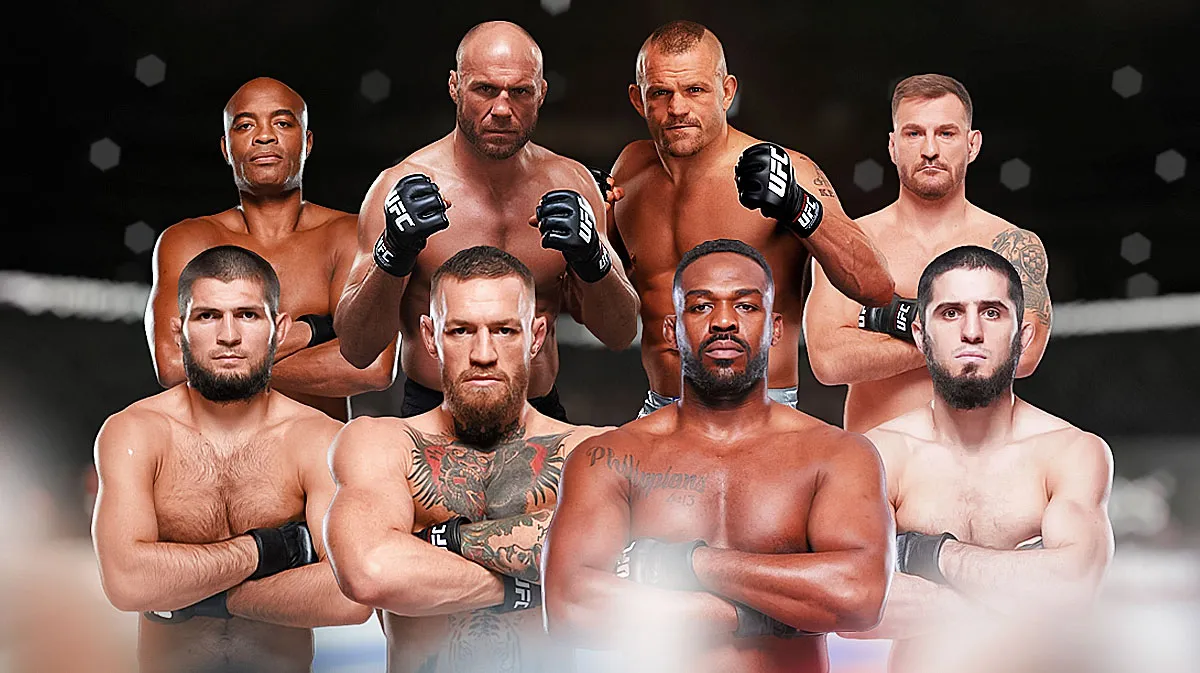
Ranking the best mixed martial artists of all time is one of combat sports’ most enduring and genuinely difficult debates, complicated by fighters competing across different eras, weight classes, organisations, and rule sets that make direct comparison inherently imperfect. Still, a handful of names consistently appear near the top of virtually every serious discussion, having demonstrated a combination of dominance, longevity, and quality of competition that sets them apart even amid this inherent difficulty in cross-era comparison.
Jon Jones stands as one of the most frequently cited candidates for the greatest of all time, having dominated the light heavyweight division for years with a style built on unconventional striking, elite wrestling, and a fighting IQ widely regarded as among the best the sport has produced. His resume includes victories over a remarkable number of former and future champions, and his later move up to heavyweight to capture a title in a second weight class added further weight to his case, even as his career has also been shadowed by disciplinary issues and suspensions outside the cage.
Khabib Nurmagomedov built a case for greatest-of-all-time status through a rarer, more absolute kind of dominance: an undefeated professional record of 29 wins and zero losses, retiring as an undefeated lightweight champion. His suffocating wrestling-based grappling style proved almost unsolvable for the elite competition he faced, and the fact that he retired at the peak of his powers, undefeated, gives his case a cleanliness that few other fighters can claim, even if his total number of title defences was fewer than some other dominant champions.
Georges St-Pierre, widely known as GSP, is frequently cited for his exceptionally well-rounded skill set and genuinely dominant multi-year reign atop the welterweight division, successfully defending his title against a series of elite challengers across nearly a decade at the top of one of the sport’s deepest weight classes. His later return to competition after a lengthy hiatus, in which he moved up to capture a title in a second weight class, further strengthened his case among fighters who have proven dominant across more than one division.
Anderson Silva’s case rests on one of the most statistically dominant title reigns in the sport’s history, defending the middleweight championship a remarkable number of consecutive times across nearly seven years, often finishing opponents in dramatic, highlight-reel fashion that showcased a striking style well ahead of its time. While his later career saw notable losses that some argue affect his overall legacy, the sheer length and dominance of his prime remains among the strongest peaks any fighter in the sport has produced.
Demetrious Johnson, competing at flyweight — a lighter weight class that historically received less mainstream attention than the higher-profile divisions — is frequently cited by analysts and fellow fighters as among the most technically complete mixed martial artists ever, having set records for consecutive title defences while showcasing a rare combination of technical mastery across every phase of the sport, from striking to wrestling to jiu-jitsu.
Fedor Emelianenko deserves inclusion in any serious discussion, having built a dominant heavyweight run predominantly in organisations outside the UFC during an era when the promotional landscape was considerably more fragmented than it is today. His extended unbeaten stretch against many of his era’s top heavyweights, combined with a calm, understated demeanour that contrasted with his ferocious performances inside the ring, made him one of the most respected fighters of his generation, even among those who never competed for the UFC’s own titles.
Amanda Nunes has built arguably the strongest case among women’s mixed martial artists, having become the first fighter, male or female, to simultaneously hold titles in two weight classes while also defeating a series of other legendary champions along the way, including victories that effectively ended the championship reigns of several previously dominant fighters in their own right, cementing her case as one of the most accomplished champions the sport has seen regardless of gender.
Ultimately, ranking these fighters against one another involves comparing genuinely different kinds of greatness — Khabib’s spotless record against Jones’s dominance across weight classes, Silva’s electrifying finishes against Johnson’s technical completeness — and reasonable, well-informed fans and analysts continue to disagree on the exact ordering. What unites this group, regardless of how they are individually ranked, is a combination of sustained excellence against elite competition and a genuine influence on how the sport itself has evolved, making each of them foundational figures in mixed martial arts history rather than simply statistically impressive competitors.
Newer names inevitably enter this conversation as the sport continues to evolve, and any list like this benefits from periodic revisiting rather than being treated as permanently fixed. Fighters currently active and building their own championship resumes may well earn a place in this discussion in years to come, which is part of what keeps the greatest-of-all-time debate a genuinely ongoing conversation rather than a settled question.
It’s also worth acknowledging that any such list inevitably reflects some degree of subjective weighting between competing values — dominance versus longevity, quality of competition versus sheer statistical output — and reasonable fans can weigh these factors quite differently while still arriving at a defensible ranking. That built-in subjectivity is precisely what keeps this debate alive and worth having, decade after decade, rather than something a single definitive list could ever fully resolve.