
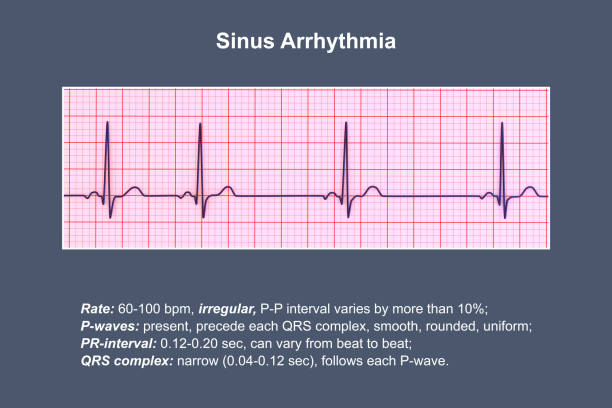
What Is Sinus Arrhythmia?
Sinus arrhythmia refers to a natural variation in heart rate that occurs in rhythm with breathing. The heart still beats in a normal pattern, originating from the sinoatrial (SA) node — the heart’s natural pacemaker — but the interval between beats slightly speeds up and slows down as a person inhales and exhales. This is technically called respiratory sinus arrhythmia, and it’s the most common form people encounter.
Despite the word “arrhythmia,” which can sound alarming, this particular pattern is usually a normal physiological finding rather than a disease. It’s especially common in children, teenagers, and young, healthy adults, and it often shows up incidentally on a routine ECG (electrocardiogram) rather than because of any symptom.
Why It Happens
Sinus arrhythmia is closely tied to the interaction between breathing and the autonomic nervous system, which regulates heart rate automatically. When you inhale, the vagus nerve’s influence on the heart temporarily decreases, letting the heart rate rise slightly. When you exhale, vagal tone increases again, slowing the heart rate back down. This subtle speeding-up-and-slowing-down pattern lines up with the breathing cycle, which is why it’s called “respiratory.”
This reflects healthy communication between the nervous system and the heart, and in many cases a stronger respiratory sinus arrhythmia pattern is actually associated with good cardiovascular fitness rather than a problem. Athletes and younger people frequently show a more pronounced version of this pattern than older adults, whose vagal tone tends to decline somewhat with age.
Common Symptoms
For most people, sinus arrhythmia produces no symptoms at all. It’s typically discovered incidentally during a physical exam, a sports physical, or an ECG done for an unrelated reason. When symptoms are noticed, they tend to be mild and may include:
- A subtle awareness of the heartbeat changing pace with breathing
- Occasional palpitations, especially when paying close attention to one’s pulse
- Mild lightheadedness in some cases, though this is less common and worth mentioning to a doctor if it happens
Because the rhythm still originates normally from the SA node and follows a predictable pattern tied to breathing, it’s fundamentally different from arrhythmias that involve chaotic or dangerous rhythms.
How It’s Diagnosed
Sinus arrhythmia is usually identified on a standard ECG, where the characteristic pattern is a heart rate that varies with the breathing cycle while the shape of each heartbeat (the P wave, QRS complex, and T wave) stays normal. A doctor may also ask the patient to hold their breath briefly during the ECG — if the irregular pattern disappears when breathing stops, that strongly confirms it’s the respiratory type rather than something else.
In most healthy people, no further testing is needed once respiratory sinus arrhythmia is confirmed. If the rhythm doesn’t correlate with breathing, or if there are additional symptoms like chest pain, fainting, or a very fast or very slow underlying heart rate, a doctor may order more testing, such as a Holter monitor (a portable ECG worn over 24–48 hours) to rule out other rhythm issues.
When to See a Doctor
Respiratory sinus arrhythmia on its own, without other symptoms, generally doesn’t require treatment and isn’t considered dangerous. However, it’s worth getting evaluated by a healthcare provider if any of the following occur alongside an irregular heartbeat:
- Chest pain or pressure
- Fainting or near-fainting episodes
- Shortness of breath that isn’t explained by exertion
- A heart rate that feels persistently very fast, very slow, or irregular even when holding your breath
- A family history of heart rhythm disorders or sudden cardiac events
These symptoms don’t necessarily mean something serious is happening, but they warrant a proper evaluation rather than self-diagnosis, since other types of arrhythmias can look superficially similar but carry different risks.
The Bottom Line
Sinus arrhythmia — specifically the respiratory type — is one of the most common and least concerning heart rhythm findings, particularly in children and younger adults. It reflects the normal push and pull between breathing and the nervous system’s control over heart rate, and in many cases it’s simply a sign of a healthy, responsive cardiovascular system. That said, any new or persistent heart-related symptoms should always be discussed with a doctor, since only a proper exam and testing can confirm what’s actually going on. This article is for general information only and isn’t a substitute for personalized medical advice.
Sinus Arrhythmia vs. Other Types of Arrhythmia
It’s worth distinguishing respiratory sinus arrhythmia from other, more serious heart rhythm disorders that also fall under the general term “arrhythmia.” Conditions like atrial fibrillation, ventricular tachycardia, or heart block involve the heart’s electrical system misfiring or conducting abnormally, which can lead to genuinely irregular, chaotic, or dangerously fast or slow rhythms. These conditions carry real risks, including stroke and heart failure, and require ongoing medical management.
Sinus arrhythmia, by contrast, still follows a completely normal, predictable pattern that starts from the SA node exactly as it should — the only thing that varies is the timing between otherwise-normal beats, and that timing change lines up neatly with breathing. This is the key distinction a doctor is checking for when reviewing an ECG: is the rhythm irregular but still organized and predictable, or is it truly chaotic? That difference is what separates a harmless, common finding from something that needs active treatment.